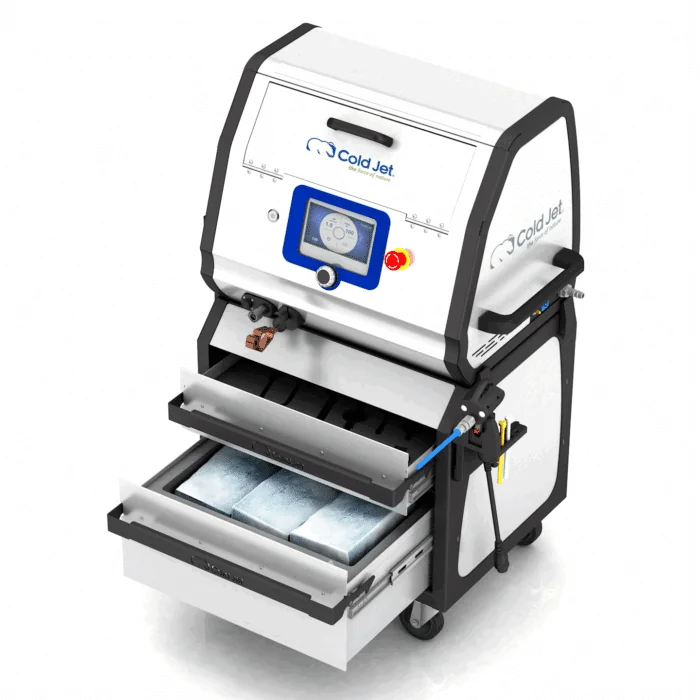
HACCP-compliant cleaning with dry ice blasting: what the NVWA and your auditor expect
HACCP compliance stands or falls with reproducible cleaning. A method that adds water or chemicals to a production environment introduces risk factors your auditor will scrutinise closely. Residual water on floors, chemicals in storage, drying time after sanitation: each of these becomes a CCP discussion. Dry ice blasting eliminates that discussion at the source.
This article describes how ColdBlast approaches HACCP-compliant cleaning with food producers. You will learn which requirements HACCP and FSSC 22000 place on your cleaning method, why water and chemicals raise your risk profile, and where dry ice blasting simplifies the audit conversation. At the end you can calculate your scenario or have a ColdBlast specialist visit on site.

What HACCP requires of your cleaning method
HACCP itself does not prescribe a specific cleaning technology. What HACCP does require is that your cleaning method demonstrably works without introducing new risks. That sounds simple, but it has four hard implications: no residual material on food-contact surfaces after cleaning, no cross-contamination between products or allergen zones, reproducible performance documented in a log, and a demonstrable link between cleaning and bacterial reduction at CCP points.
Most food producers ColdBlast speaks to score well on the first three points with their existing methods. On the fourth, evidence of bacterial reduction without secondary contamination, traditional methods run into trouble more often than you might expect. This is where dry ice blasting offers a simpler audit conversation.
Why water and chemicals raise your HACCP risk
Water and chemicals are the two most-used cleaning routes in food. Both add variables your QA team must continuously monitor. Water on floors becomes a listeria risk as soon as drying time falls short. Chemical residual levels must be measured before every production start. PPE protocols around aggressive chemicals add to your operator training. And through water treatment requirements, wastewater discharge becomes a measurable part of your environmental permit.
FSSC 22000 and BRCGS audit reports cite “control of secondary contamination after cleaning” almost as standard. Food producers that clean with water or chemicals almost always get questions on this point. The method is not fundamentally unsafe; the burden of proof is simply higher.
How dry ice blasting meets HACCP-CCP requirements
Dry ice blasting uses solid CO2 pellets under compressed air. The pellets sublimate on contact and leave no residue: no water, no chemicals and no secondary contamination. ColdBlast configures pellet size and blasting pressure per food environment, so soft contamination is removed with fine pellets at low pressure and hard buildup with coarser pellets at higher pressure.
For your HACCP documentation ColdBlast supplies a template CCP procedure with every delivered machine. It specifies cleaning frequency, pellet configuration per surface type, operator checks, and the link with your existing sanitation log. Your auditor recognises this format and does not have to re-validate whether the method is HACCP-compliant.
Per sector: HACCP applicability
| Sector | HACCP focus point | Dry ice solution |
|---|---|---|
| Bakery and patisserie | Carbonisation in ovens, allergen switching between products | i³ MicroClean 2 with fine pellets at production temperature; no drying time |
| Meat and fish processing | Listeria control on cooling installations and conveyors | Aero 40FP with variable pressure; dry cleaning without water residue |
| Dairy | Pasteurisation equipment, product switching between recipes | i³ MicroClean 2 at temperature; preserves pasteurisation cycle |
| Chocolate and confectionery | Allergens (nuts, dairy), cross-contamination between ingredients | Cold Jet PCS Ultra; pellet size adjustable per allergen zone |
| Packaging and filling lines | Adhesive residue, label remnants, hygiene zone transitions | Aero 40FP or i³ MicroClean 2 for delicate filling components |
Audit conformity per standard
| Standard | Cleaning requirement | Dry ice status |
|---|---|---|
| HACCP (Codex Alimentarius) | Cleaning method must not introduce new hazards | Compliant: no water, no chemicals, no residue |
| FSSC 22000 | Demonstrable bacterial reduction without secondary contamination | Compliant with the correct pellet configuration; ColdBlast supplies CCP template |
| BRCGS Food Safety | Cleaning validation per CCP, allergen management | Compliant: pellet size per allergen zone, validated in maintenance log |
| IFS Food | Documented cleaning protocols, operator training | Compliant: ColdBlast supplies protocols and operator certification |
| NVWA inspections | Hygiene zoning, cleaning frequency, no cross-contamination | Compliant: dry ice reduces cross-contamination versus wet methods |
Request a HACCP scan for your production
Does dry ice blasting fit your HACCP protocol and CCP requirements? ColdBlast comes on site for a HACCP scan. We assess your current cleaning route, identify the audit risks and demonstrate dry ice blasting on your own contamination.
Request HACCP scan →Want to calculate what an in-house Cold Jet machine would yield versus your current sanitation costs? Our ROI calculator runs your operator rate, sanitation frequency and downtime cost through a 5-year comparison.
Frequently asked questions
Is dry ice blasting food grade?
Yes. Dry ice (solid CO2) is FDA-, USDA- and EPA-approved for contact with food surfaces. ColdBlast supplies pellets and machines within this certification. For your HACCP documentation we provide the relevant material certificates on request.
How do I prevent listeria risk during cleaning?
Listeria thrives on moist surfaces. Cleaning methods using water extend the risk window. Dry ice blasting is fully dry and cools the surface only briefly and locally. ColdBlast recommends dry ice blasting at specific listeria CCP points in dairy, meat and ready-to-eat products.
Does dry ice blasting work at production temperature?
Yes. This is the standard application for in-line cleaning. Pellets sublimate on contact and cool the surface briefly and locally. For ovens, cooling installations or pasteurisation equipment this means the cycle does not have to be interrupted for cooling and restart.
How do I document dry ice blasting in my HACCP plan?
ColdBlast provides a template CCP procedure with every machine that integrates into your existing HACCP plan. It contains pellet configuration per surface type, cleaning frequency, operator checks and the link with your sanitation log. Auditors recognise the format.
How does dry ice blasting prevent cross-contamination between allergens?
By cleaning completely residue-free between production runs: there is no water to spread allergens and no chemical residue to react with the next batch. ColdBlast recommends the Cold Jet PCS Ultra with adjustable pellet size per allergen zone.
What does the NVWA say about dry ice blasting?
The NVWA does not impose specific cleaning technology requirements; what matters is that your method is HACCP-compliant and introduces no risks. Dry ice blasting meets these requirements when executed and documented according to your CCP procedure. ColdBlast advises on the correct documentation route per situation.
What is the bacterial log reduction of dry ice blasting?
Independent studies show log reductions of 3 to 5 on typical food pathogens with the correct pellet configuration and blasting pressure. ColdBlast supplies these validation reports on request for specified applications, so you can present them in your FSSC 22000 or BRCGS audit.