


In-press cleaning of injection molds
The traditional mold cleaning cycle is expensive. Stop the injection molding machine, disassemble the mold, move it to the maintenance workshop, clean, dry, return to the press, re-register and warm up again. Two to four hours per mold, and with several molds per week the lost production adds up fast.
In-press cleaning with Cold Jet dry ice blasting skips the entire disassembly step. The mold stays in the press, you clean in 15 to 45 minutes and resume production. This article explains how in-press cleaning works in practice, which Cold Jet machine is used and what the ROI looks like.
Why out-of-press cleaning hits a wall
A typical injection mold weighs several hundred kilos up to multiple tonnes. Disassembly needs a crane, two technicians and 30 to 60 minutes of labor just to remove and reinstall it. The cleaning itself takes 1 to 2 hours. Rebuild and re-registration take another 30 to 60 minutes. Warming the press back up typically takes 45 to 90 minutes.
Total per mold: 3 to 5 hours of lost production. Per week, per mold, per cycle. For injection molding plants with several molds and weekly cleaning that quickly runs into dozens of hours of lost production per week.
How in-press cleaning works
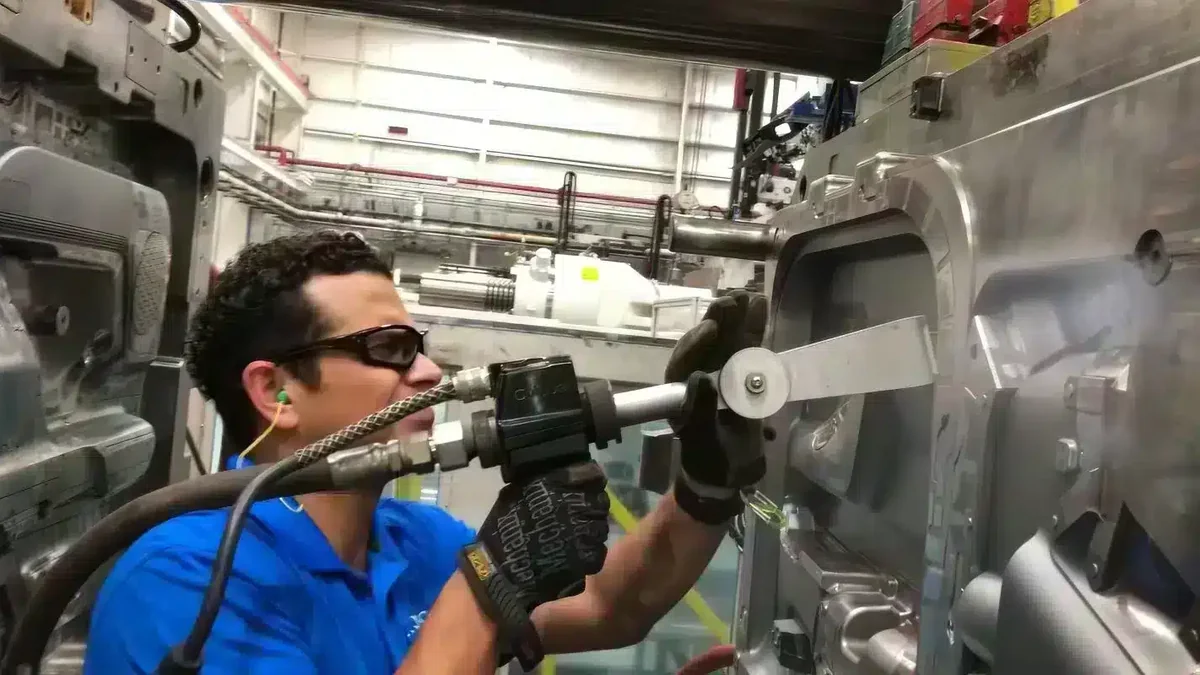
The mold stays in the injection molding machine. The operator opens the press, briefly closes the water channel if needed, and aims the Cold Jet blast gun at the mold surface. Dry ice pellets sublimate on impact and blow away release agent residue, gas fouling in vents and carbonized plastic.
No disassembly, no cool-down, no re-registration. For most molds the full process takes 15 to 45 minutes depending on complexity. The press stays at temperature and production can restart almost immediately.
Concrete benefits of in-press cleaning
- ✓Cycle-time reduction of 75 to 90 percent
- ✓No disassembly, no crane and no technicians needed
- ✓No mold re-registration
- ✓Press stays at temperature; no warm-up time
- ✓Cleans vents, cavities and fine details
- ✓Non-abrasive; the polished mold finish stays intact
- ✓No moisture in mold cooling channels
- ✓Extends mold service life through less mechanical wear
- ✓One operator handles the full cycle
Which Cold Jet machine for in-press cleaning
The PCS Ultra is the recommended choice for in-press cleaning. The Particle Control® system offers 28 different pellet sizes, so one machine covers delicate cavity cleaning through to heavy fouling removal. Programmed recipes per mold speed up the operator procedure.
For heavier molds or higher-pressure applications you can step up to the PLT Ultra with a 17.2 bar working pressure. Both feature IoT controls through Cold Jet CONNECT® for service data and an audit trail.
Typical in-press applications
| Contamination | Cold Jet approach | Time per cycle |
|---|---|---|
| Release agent residue | Standard PCS setting, 0.3 to 1 mm pellets | 15 to 25 minutes |
| Gas fouling in vents | Fine pellets, targeted blast | 10 to 20 minutes |
| Carbonized plastic | Coarser pellets, higher pressure | 30 to 45 minutes |
| Plate-out (silicone or wax) | Standard setting | 20 to 30 minutes |
| Resin residue in cavities | Fine pellets, lower pressure | 25 to 40 minutes |
Recommended Cold Jet machines for in-press cleaning
The PCS Ultra is the standard choice for in-press cleaning thanks to its 28 selectable particle sizes and programmed recipes per mold. For heavier molds or higher-pressure applications you can step up to the PLT Ultra with a 17.2 bar working pressure.
Related mold cleaning applications
- ✓Screw and barrel cleaning with dry ice blasting
- ✓Blow molding cleaning with dry ice blasting
- ✓Rubber mold cleaning with dry ice blasting
Want to test in-press cleaning on your own injection mold? We come on site with a PCS Ultra for a no-obligation demo.
Request a demo →Frequently asked questions
What exactly is in-press cleaning?
In-press cleaning means you leave the injection mold in the press during cleaning. No disassembly, no cool-down, no re-registration. The operator opens the press, cleans with Cold Jet in 15 to 45 minutes and closes it again. Production can restart within an hour.
Which Cold Jet machine is best for in-press cleaning?
The PCS Ultra is the strongest fit. It offers 28 selectable pellet sizes for varied mold types, programmed recipes per mold and a compact mobile setup. For heavier molds you can also use the PLT Ultra.
How much cycle time do I save with in-press cleaning?
Compared with traditional mold cleaning in which you remove the mold from the press, typically 75 to 90 percent. A 4-hour traditional cycle becomes 15 to 45 minutes in-press. On an annual basis that is dozens to hundreds of extra production hours.
Does in-press cleaning fit every mold?
For most standard molds, yes. For very complex multi-cavity molds with narrow vents specific settings may be required. For very hot molds we recommend a short cooling pause before cleaning. Our specialist assesses your mold portfolio.
Does dry ice blasting damage the mold finish?
No, dry ice pellets are non-abrasive. The polished mold finish stays intact. Cold Jet is proven safe for steel, stainless steel, polymers and anodized mold surfaces. When in doubt we test first on a less critical area.