


Dry ice blasting in the chocolate industry
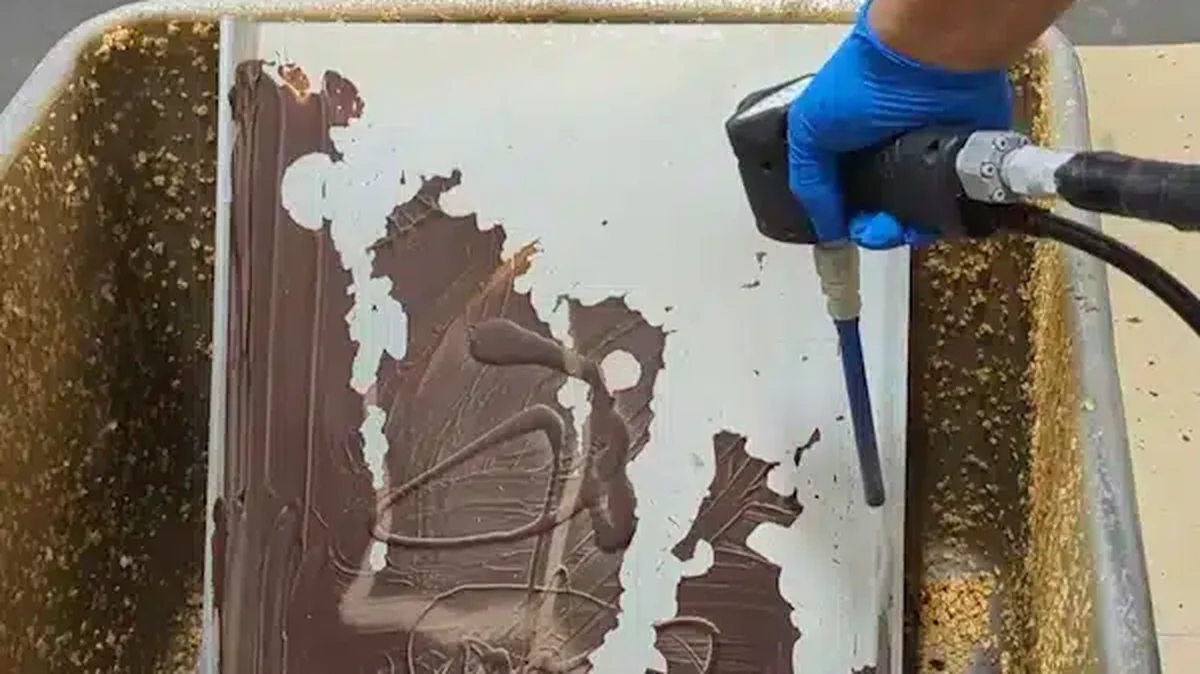
Chocolate production is a constant fight against residue. Conches, tempering machines, molds, cooling belts and dosing lines collect hardened chocolate, cocoa butter and potential allergens like nuts. Conventional cleaning requires cooling down to working temperature, mold disassembly and hours of manual scrubbing.
Cold Jet dry ice blasting works on both warm and chilled equipment, is non-abrasive on polished molds and uses no water. This article covers how the technology plays out in chocolate production and which Cold Jet machine fits your line.
Why traditional cleaning falls short in chocolate
Chocolate sticks to steel as it cools. Hardened residue in conches and dosing lines is hard to remove with spatulas or warm water. Water is also a no-go for much chocolate equipment because moisture can damage the finish and creates bacterial growth risk.
For producers switching between dark, milk and hazelnut, allergens must be fully removed. With manual work and chemistry you risk leftover traces in unreachable corners. That is not acceptable under current allergen regulations.
How dry ice blasting works on chocolate equipment
Cold Jet pellets accelerated by compressed air hit the surface and sublimate on impact into CO₂ gas. The thermal shock at minus 79 degrees Celsius contracts the hardened chocolate; gas expansion blows the residue away. No water, no chemistry, no moisture in tempering coils.
For polished molds the PCS Ultra runs on fine pellets (from 0.3 mm) without attacking the finish. For heavier conches and dosing lines you switch within the same machine to coarser pellets and higher pressure.
Concrete benefits for chocolate production
- ✓Non-abrasive on polished chocolate molds and dosing lines
- ✓Full allergen removal between dark, milk and nut runs
- ✓No water in tempering coils or electronics
- ✓Cleans complex geometries on conches and dosing heads
- ✓Cuts product changeover time from hours to minutes
- ✓No secondary waste; only released chocolate to vacuum away
- ✓Safe in chilled production environments with proper ventilation
- ✓FDA, USDA and EPA approved for food applications
Applications in chocolate production
Cold Jet is deployed in nearly every step of chocolate production. The right configuration depends on the specific equipment and contamination level.
| Equipment | Contamination | Recommended machine |
|---|---|---|
| Conches | Hardened chocolate, cocoa butter | PCS Ultra |
| Tempering machines | Residue in coils and pumps | PCS Ultra / i³ MicroClean 2 |
| Chocolate molds (polycarbonate) | Hardened chocolate residue | i³ MicroClean 2 (fine pellets) |
| Dosing lines and nozzles | Stuck-on chocolate | PCS Ultra |
| Cooling belts | Chocolate spatter, dry residue | Aero 40FP |
| Wrapping and packaging machines | Adhesive residue, chocolate dust | PCS Ultra |
Recommended Cold Jet machines for chocolate production
For delicate polished molds and dosing lines, PCS Ultra and i³ MicroClean 2 work best. The PCS Ultra is versatile thanks to 28 selectable particle sizes; the i³ MicroClean 2 adds IoT operation via Cold Jet CONNECT®.
Related applications in food production
- ✓Dry ice blasting in bakery
- ✓Dry ice blasting in dairy
- ✓Dry ice blasting in meat and slaughterhouse
- ✓Dry ice blasting in packaging
Want to test dry ice blasting on your own conche or mold? Request a no-obligation on-site demo.
Request a demo →Frequently asked questions
Does dry ice blasting damage polished chocolate molds?
No, dry ice blasting is non-abrasive. Cold Jet pellets sublimate on impact and have no abrasive effect on polished steel, polycarbonate or food-grade plastic molds. The finish stays intact, even with daily cleaning.
Can I switch between dark and hazelnut chocolate without cross-contamination?
Yes, that is one of the strongest use cases. Cold Jet fully removes allergenic residue (nuts, milk) without introducing contamination risk through water or chemistry. We deliver allergen-management documentation.
How long does it take to clean a chocolate conche or tempering machine?
Conches and tempering machines that take 4 to 6 hours by hand are clean with Cold Jet in 60 to 90 minutes. For a dosing line with multiple outputs, expect 30 to 45 minutes.
Which Cold Jet machine do you recommend for chocolate?
The i³ MicroClean 2 or PCS Ultra. Both offer fine control over particle size for delicate molds and heavier control for hardened chocolate fouling. The PCS Ultra is more versatile if you have multiple applications.
Is dry ice blasting safe in a chilled production environment?
Yes, provided ventilation is adequate. Cold Jet sublimation releases CO₂ gas that disperses into the air. In chilled spaces we recommend CO₂ sensors and mechanical ventilation during cleaning. We guide the safety procedure at installation.