


What does dry ice blasting really cost? A TCO comparison for production sites
Anyone comparing quotes for industrial cleaning often compares apples with oranges. The purchase price of a dry ice blasting machine is typically 20 to 25 percent of the actual cost over five years. The rest hides in downtime, operator hours, water, chemicals, dry ice pellets and service. Companies that ignore these end up paying hundreds of thousands more than expected.
This article explains what dry ice blasting really costs in a fair 5-year TCO. You get an eight-line cost model, a direct comparison with chemical cleaning, foam cleaning and soda blasting, and sector examples from food and injection molding. At the end, you can run your own scenario directly in our ROI calculator.
Why standalone quotes do not tell you your TCO
A quote for dry ice blasting gives you one number. The investment. Or the annual price of an external cleaning service. What the quote does not show is what cleaning actually costs you in the production line next to it. Operator hours keep running. Downtime hours are pure margin loss. Residual waste costs disposal. Water and chemicals have their own bill.
In practice ColdBlast sees production companies structurally underestimate four cost items. Downtime beyond the cleaning moment itself. Drying time after wet cleaning. Surface damage from abrasive methods. And the labor percentage that cleaning consumes from your maintenance team. Only those who include all four compare fairly.
What TCO contains for dry ice blasting
We calculate TCO over eight items across five years. That is the horizon at which a Cold Jet dry ice blasting machine pays back under regular use. Shorter is misleading. Longer overstates depreciation.
| Cost item | Detail |
|---|---|
| Investment | Purchase or lease value of the machine, accessories and integration. ColdBlast supplies Cold Jet entry models from around 15,000 euros and heavy-duty configurations up to 60,000 euros. |
| Dry ice pellets | Indicatively 1.50 to 3.00 euros per kilogram. Consumption depends on pellet size (1, 1.5 or 3 mm) and blasting pressure. |
| Compressed air | An existing 7-10 bar compressor usually suffices. No separate investment required. |
| Operator hours | One operator per machine. Cleaning time in our practice is 40 to 70 percent shorter than manual or wet cleaning. |
| Downtime | In-press cleaning for molds eliminates teardown. In food, this cuts weekly sanitation stops by hours. |
| Service and maintenance | Annual inspection, preventive maintenance and original Cold Jet parts via ColdBlast Wateringen. |
| Residual waste and disposal | None. Dry ice sublimates. Only the removed contamination remains. |
| Water and chemicals | Zero. No water treatment costs, no chemical procurement, no regulatory overhead for storage and use. |
5-year TCO compared with alternatives
The table below shows an indicative 5-year TCO for a typical production environment with two to three cleaning hours per week. Figures are orders of magnitude; your situation can differ on dry ice consumption, machine choice and current operator rate.
| Method | Investment | Annual OPEX | Downtime cost/year | 5-year TCO |
|---|---|---|---|---|
| Cold Jet dry ice blasting | 25,000-35,000 | 8,000-12,000 | 5,000-15,000 | 90,000-150,000 |
| Chemical cleaning | 2,000-5,000 | 25,000-40,000 | 30,000-60,000 | 277,000-525,000 |
| Foam cleaning | 5,000-10,000 | 18,000-30,000 | 20,000-45,000 | 195,000-385,000 |
| Soda blasting | 15,000-25,000 | 15,000-25,000 | 15,000-35,000 | 165,000-325,000 |
The biggest win does not sit in OPEX. It sits in downtime. A chemical cleaning cycle for an injection mold takes four to six hours per session on average; dry ice blasting brings that down to one to two hours, often without teardown. At twenty production hours per day this quickly adds up to tens of thousands of euros per year.
What this means per sector
Food industry: in food, the OPEX wins on water, chemicals and sanitation time dominate. Dry ice blasting is HACCP-compliant and non-abrasive; production lines can stay in place during cleaning. ColdBlast sees structural savings at bakery and meat-processing customers on the weekly sanitation stop, while audit compliance for FSSC 22000 and BRCGS is preserved.
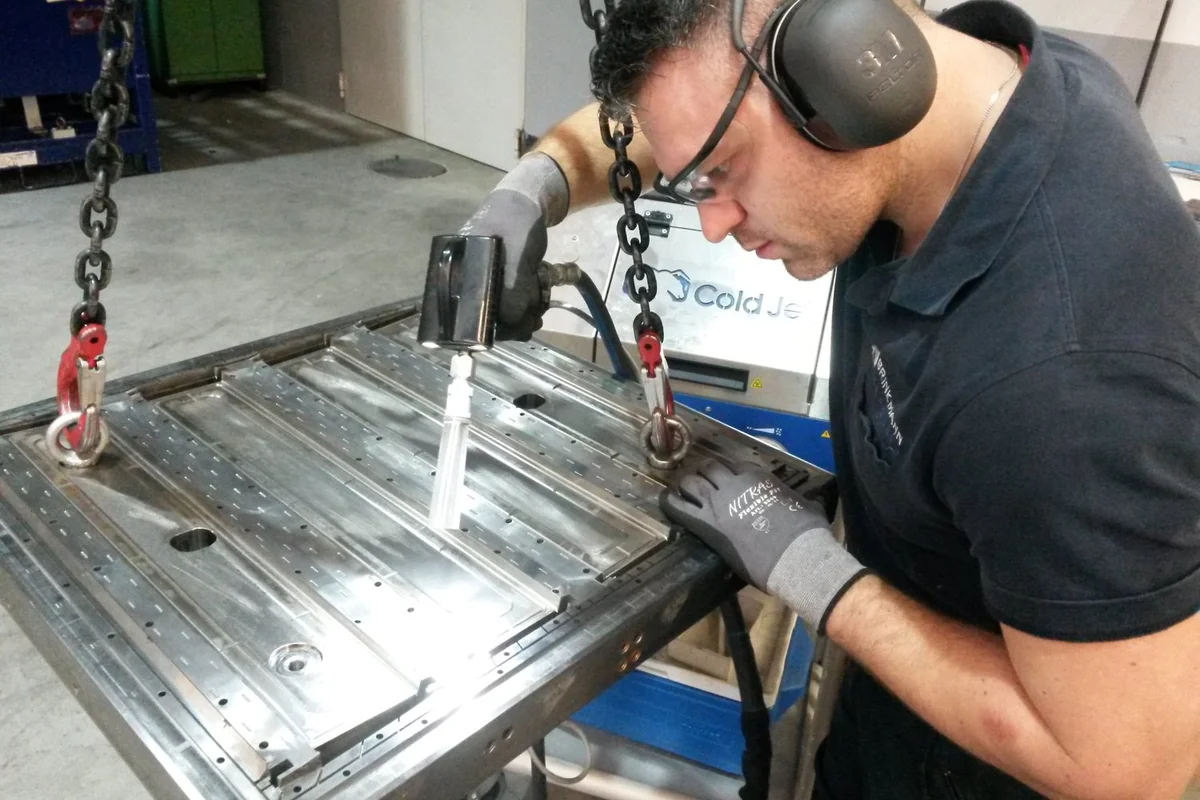
Injection molding: here the downtime win dominates. In-press cleaning of molds eliminates teardown. Operators clean with a PCS Ultra or i³ MicroClean 2 inside the press, at operating temperature. A typical injection molder with eight molds cleaned weekly sees up to 70 percent shorter downtime per cycle in practice.
Calculate your own TCO in 2 minutes
Want to calculate your own 5-year TCO right now? Our ROI calculator asks for your cleaning frequency, operator rate and downtime cost. You see your annual savings and payback period on a Cold Jet machine within two minutes.
Calculate my TCO →Prefer to walk through your situation with our specialist directly? Request a personal TCO scan. We calculate your scenario case-specific on your production hours, cleaning regime and current cost structure. Request TCO scan →
Frequently asked questions
What does a Cold Jet dry ice blasting machine cost?
ColdBlast supplies Cold Jet entry models for delicate cleaning from 15,000 euros. Heavy-duty configurations with Particle Control System reach above 60,000 euros. Second-hand demo units with dealer warranty are available at ColdBlast from around 12,000 euros. For current pricing and lease options see our financing page.
How do dry ice blasting costs compare with foam cleaning?
Dry ice blasting has a higher upfront investment. Foam cleaning is cheaper to buy. Over five years dry ice wins on TCO because foam consistently adds water, chemicals, drying time and sanitation hours. In food environments the TCO advantage for dry ice typically lands between 30 and 50 percent over five years.
What does dry ice cost per kilogram?
Dry ice pellets cost indicatively 1.50 to 3.00 euros per kilogram, depending on pellet size and delivery frequency. Consumption per cleaning session depends on blasting pressure and pellet size. In most production environments consumption sits between 10 and 30 kilograms per hour of blasting time.
What is the payback period on a Cold Jet machine?
For production companies with regular cleaning the payback period usually lands between 12 and 24 months. Faster payback is possible with high downtime costs, many mold changes or intensive sanitation requirements. Our ROI calculator runs your scenario directly.
Does mold cleaning with dry ice cost more or less than chemical?
Per session, direct material costs for dry ice are slightly higher than a chemical cleaning cycle. Because dry ice blasting works in-press without teardown and without drying time, downtime falls up to three times shorter. Across a production year, dry ice therefore wins on TCO at virtually every injection molder.
Which hidden costs hide in chemical cleaning?
Chemical procurement is only part of it. Add to that: water consumption and water treatment, drying time after cleaning, personal protective equipment, regulatory compliance for storage and use, material wear from abrasion, and the hours your maintenance team spends on teardown and reassembly.
Does lease lower the threshold for a Cold Jet machine?
Leasing removes the one-off investment and spreads cost over a fixed monthly fee. For production companies that want to validate the technology first or keep their balance sheet unloaded, this is an attractive option. See the lease options at ColdBlast for details on terms and machine selection.
