


How does dry ice blasting work? The technology explained
Dry ice blasting is an industrial cleaning technology that uses solid CO₂ pellets as a blast medium. The combination of kinetic energy, thermal shock and direct sublimation makes the method suitable for production environments where water or chemistry is not an option. Cold Jet holds more than 250 patents on the technology.
Below you read exactly how the technology works, which physical principles drive it, how dry ice blasting compares to other cleaning methods and which contamination you can tackle with it. ColdBlast is the official Cold Jet dealer in the Netherlands; we supply machines, training and service.
What exactly is dry ice?
Dry ice is the solid form of CO₂ (carbon dioxide). At atmospheric pressure dry ice has a temperature of minus 79 degrees Celsius. Unlike regular ice, dry ice skips the liquid phase and goes directly from solid to gas via sublimation. That is precisely what makes the technology workable.
Industrial cleaning uses dry ice pellets. Standard 3 mm diameter, food-grade CO₂ quality, produced from CO₂ released as a byproduct of industrial processes. The CO₂ is reused, so the cleaning step itself adds no net emissions.
The cleaning process in four steps
Dry ice blasting works on a combination of three forces that interact within milliseconds. Here is what happens the moment a pellet hits the surface.
| Step | What happens | Effect |
|---|---|---|
| 1. Acceleration | Compressed air accelerates the pellets to 200-300 m/s through a blast gun | Kinetic impact on the surface |
| 2. Thermal shock | At minus 79 °C the contamination contracts faster than the underlying material | Microscopic cracks form in the contamination layer |
| 3. Sublimation and micro-explosion | The dry ice converts directly into CO₂ gas; volume expands 700x | Gas expansion blows the contamination off the surface |
| 4. CO₂ disperses | The gas mixes with the ambient air | Only the released contamination remains |
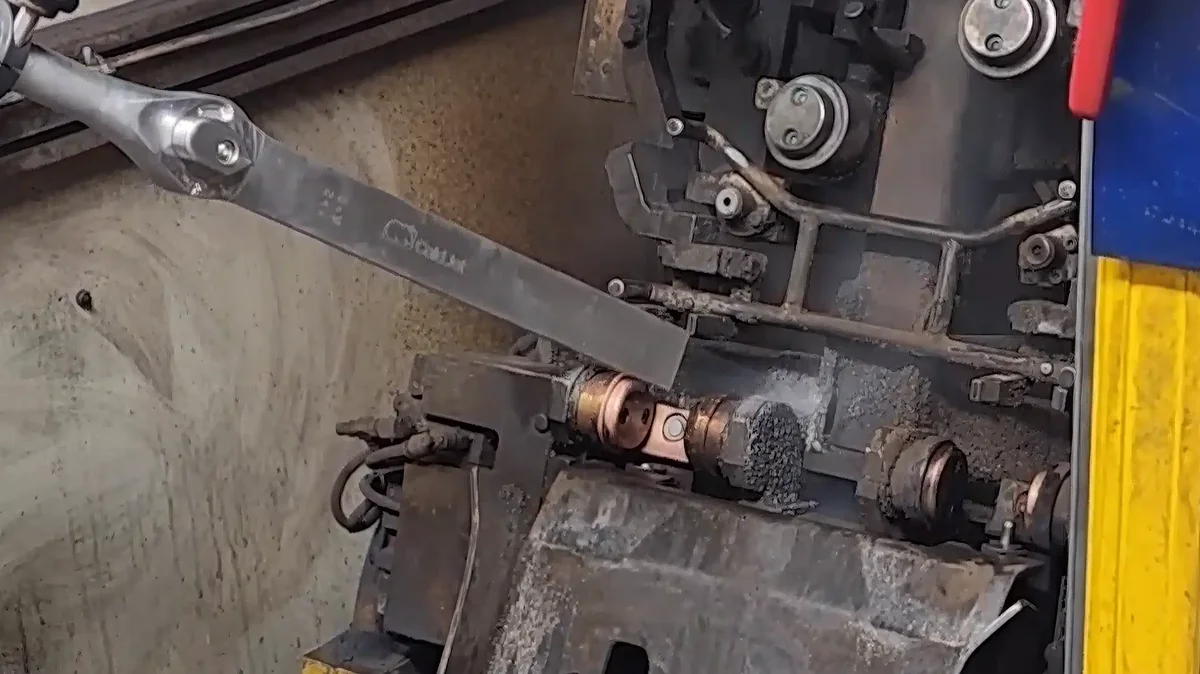
The three forces working together
What distinguishes dry ice blasting from other methods is that none of the three forces does the work alone. Kinetic energy loosens the contamination. Thermal shock cracks the adhesion. Gas expansion blows the contamination away. Only in combination is the effect strong enough for industrial cleaning without surface damage.
Conventional methods like sandblasting rely fully on kinetic impact and are therefore abrasive. Chemical cleaning relies on dissolving properties and introduces residue. High-pressure water uses impact plus dissolving but leaves moisture behind. Dry ice blasting combines all three forces without those drawbacks.
Properties of the technology
- ✓Non-abrasive: does not attack surfaces (steel, stainless steel, aluminum, polished finishes)
- ✓Non-conductive: safe for electronics, motors, sensors and bearings
- ✓Fully dry process: no moisture in equipment or installations
- ✓Food-grade: FDA, USDA and EPA approved for the food industry
- ✓No secondary waste: only the released contamination remains
- ✓Works on hot surfaces: no cooling time required (exceptions above 200 °C)
- ✓Reaches complex geometries: vents, cavities, screw segments
- ✓Consistent quality: less operator-dependent than manual scrubbing

Comparison with other cleaning methods
No cleaning method is universally best. For some applications sandblasting or laser cleaning fits better. For most industrial situations where surface integrity, hygiene or downtime is critical, dry ice blasting scores well on multiple axes at once.
| Method | Abrasive | Moisture | Chemistry | Residual waste | Electronics-safe |
|---|---|---|---|---|---|
| Dry ice blasting | No | No | No | None | Yes |
| Sandblasting | Yes | No | No | High | No |
| Soda blasting | Light | Sometimes | Soda residue | Some | Limited |
| High-pressure water | No | Yes | Sometimes | Wastewater | No |
| Chemical cleaning | No | Often | Yes | Chemicals | Limited |
| Laser cleaning | No | No | No | None | Yes |
| Ultrasonic | No | Yes (liquid bath) | Often | Liquid | No |
Which contamination does dry ice blasting tackle?
The technology works best on hard surfaces with adhering contamination that releases thermally. The typical applications for the ten most common contamination types are listed below.
| Contamination | Works on | Typical sectors |
|---|---|---|
| Release agent residue | Molds and forms | Injection molding, blow molding |
| Carbonized plastic | Screws, barrels, feed heads | Injection molding |
| Grease build-up and burned-on oil | Ovens, fryers, mixers | Bakery, meat processing |
| Adhesive residue and hot-melt | Sealers, applicators, chains | Packaging |
| Ink fouling and plate-out | Flexo presses, anilox rolls | Printing |
| Protein deposits | Pasteurizers, cheese molds | Dairy |
| Fire and soot damage | Real estate, machinery | Restoration, cleaning services |
| Weld slag and spatter | Weld cells, jigs | Automotive, metal fabrication |
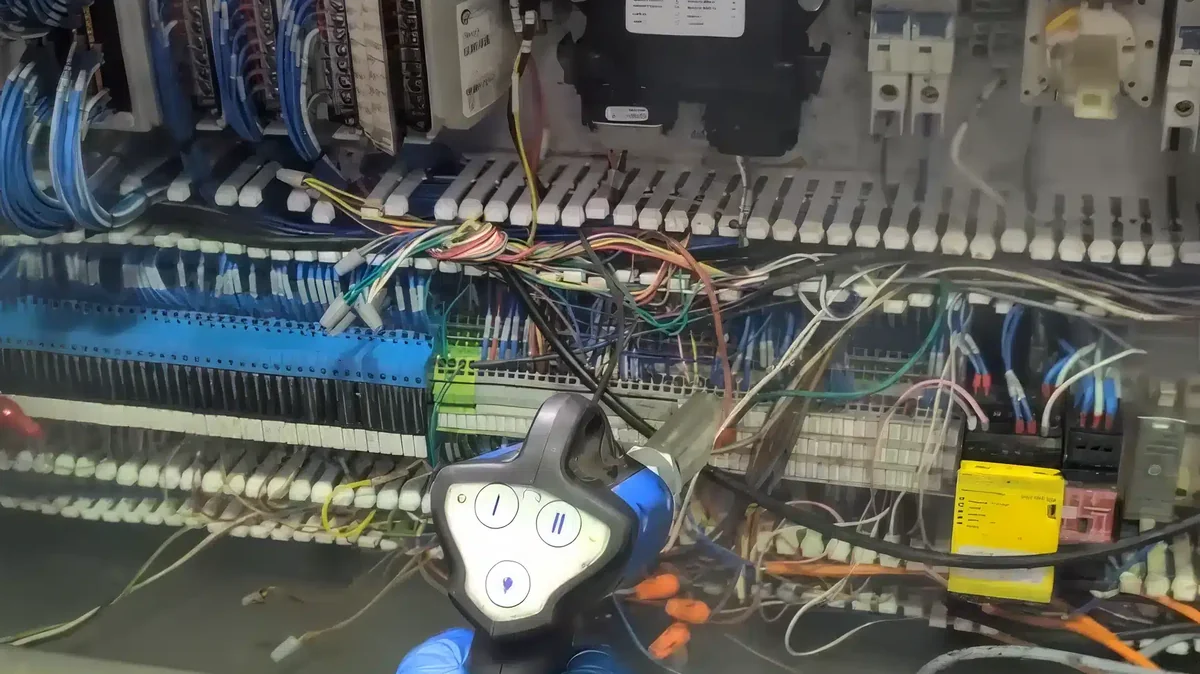
| Fouling and dust in electronics | Switch cabinets, motors | Electrical engineering |
| Rubber residue | Tire and rubber molds | Rubber industry |
Safety and environment
The CO₂ released during dry ice blasting is non-toxic, but in enclosed spaces the concentration does need monitoring. Our training covers CO₂ safety, ventilation, hearing protection and correct use of personal protective equipment.
From an environmental perspective dry ice blasting offers three distinct advantages. The CO₂ is reused from industrial byproducts and produces no net emissions. There is no water consumption and no wastewater. There are no chemicals with disposal or storage requirements. For companies with ESG targets or strict wastewater levies, that yields substantial savings.
Cold Jet: deep specialist in dry ice blasting technology
Cold Jet has developed dry ice blasting machines since 1986 and holds more than 250 patents on the technology. Worldwide more than 10,000 Cold Jet machines are in use at production companies across food, automotive, injection molding, electrical engineering and petrochemicals.
ColdBlast is the official Cold Jet dealer in the Netherlands. That means factory warranty, original parts and factory-trained engineers. View the full Cold Jet machine line-up or read on the official dealer page what that means concretely for service and warranty.

Want to test dry ice blasting on your own cleaning challenge? We come on-site for a no-obligation demo with a Cold Jet machine.
Request a demo →Frequently asked questions
What’s the difference between dry ice blasting and sandblasting?
Sandblasting uses abrasive particles (sand, corundum, glass beads) that scour the surface. Dry ice blasting uses soft CO₂ pellets that sublimate into gas on impact. The difference: sandblasting produces secondary waste and attacks the surface; dry ice blasting leaves the surface intact and has no blast medium to dispose of.
How much compressed air does a Cold Jet machine need?
It depends on the model. The entry-level IceRocket runs on 2-10 bar and around 1 m³/min. The heavier Aero 80FP or PLT Ultra needs 7-12 bar and up to 5 m³/min. We verify on-site whether your existing compressor fits.
Is dry ice blasting safe for my employees?
Yes, provided ventilation is adequate. The main points of attention are CO₂ concentration (enclosed spaces require a CO₂ sensor), noise level (comparable to high-pressure cleaning; hearing protection recommended), and skin contact (gloves, eye protection). Our operator training covers these procedures.
Does dry ice blasting work on hot surfaces?
Yes. The thermal shock actually works better on warm equipment because the temperature difference is larger. Baking ovens, injection molds and pasteurizers can be cleaned at operating temperature. For very hot surfaces (above 200 °C) we do recommend a brief cooling pause.
How much time do I save versus manual cleaning?
It depends on the application. Bakery ovens: 70-85 percent time saved. Injection molds in-press: 75-90 percent. Heavy industrial installations: 50-70 percent. We deliver concrete numbers after an on-site demo.
Which Cold Jet machine fits my production?
It depends on your type of contamination and surface. For delicate electronics the i³ MicroClean series; for heavy industrial installations the Aero 80FP or PLT Ultra; for variable applications the PCS Ultra with Particle Control System. Compare all 9 models on the overview page.
Can I test dry ice blasting before purchase?
Yes, we come on-site for a demo on your own contamination. You see directly how the technology performs on your specific challenge. For structural use you can then choose between buying, leasing via our partner or a pre-owned demo unit.