


Mold cleaning with dry ice blasting
Cleaning injection molds costs time and money. Manual scrubbing requires disassembly, hours of labor and rebuild. Chemical cleaning carries risk for the finish and for operators. Both methods consume production hours that you would rather spend on cycles. And yet regular cleaning is unavoidable; release agent residue, gas fouling in vents and carbonized plastic push your OEE down.
Dry ice blasting offers a third route: non-abrasive, without disassembly and often in-press. This article explains how it works on injection molds, which Cold Jet machines see the most use and what the ROI looks like in practice.
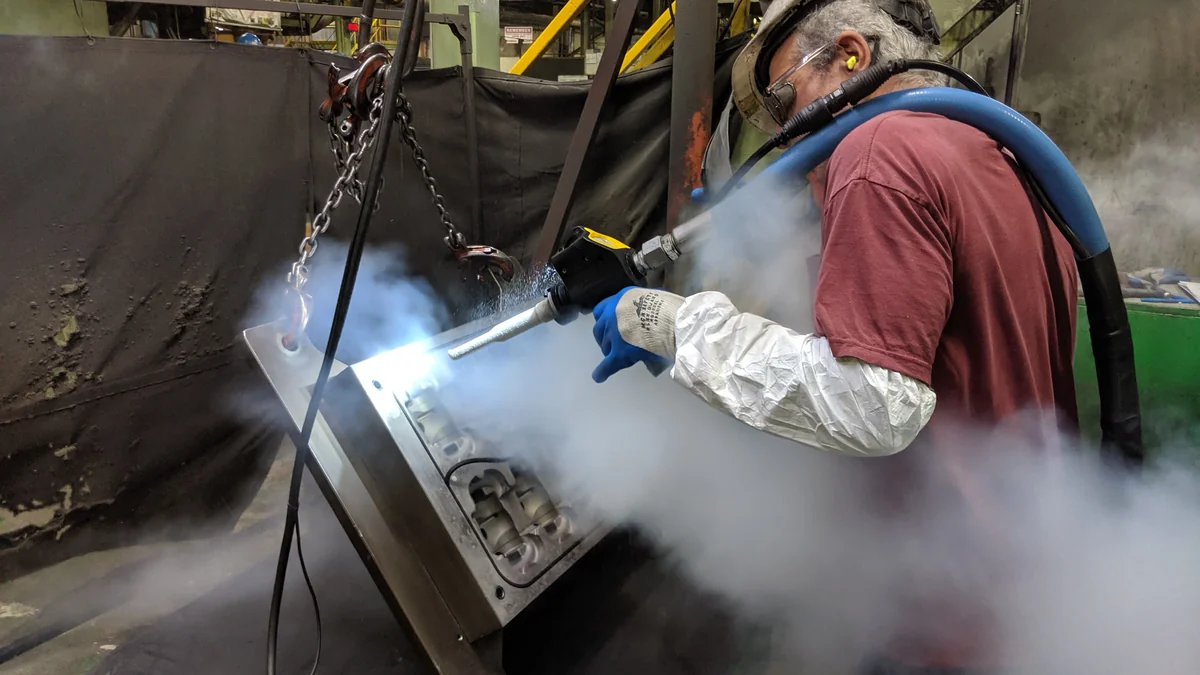
Why manual mold cleaning hits a wall
The traditional approach: stop the injection molding machine, pull the mold from the press, take it to the maintenance workshop, scrub manually with solvent or a steel brush, dry, return to the press, warm back up. Time per cycle: 2 to 4 hours. Per mold per week, that quickly adds up to dozens of hours of lost production.
On top of that comes wear. Steel brushes and abrasive methods damage polished mold surfaces and shorten their service life. Chemical cleaners require rinse steps and carry safety risks. Molds with fine vent channels or complex cavity geometry have areas that stay structurally unreachable.
How dry ice blasting cleans molds
Dry ice pellets accelerated by compressed air hit the mold surface with a combination of kinetic energy and thermal shock of minus 79 degrees Celsius. The contamination contracts faster than the steel, cracks form in the fouling, the dry ice sublimates on impact and gas expansion blows the contamination away. The result is a clean mold without disassembly, without moisture and without damage to the finish.
For in-press cleaning the mold stays in the injection molding machine. The operator opens the press, cleans for 15 to 45 minutes and closes it again. No cool-down, no warm-up, no re-registration. Cycle-time reduction of 75 to 90 percent compared with manual cleaning.
Concrete benefits for injection molding
- ✓In-press cleaning: the mold stays in the press
- ✓Cycle-time reduction of 75 to 90 percent
- ✓No disassembly and rebuild
- ✓Non-abrasive; the polished mold finish stays intact
- ✓No moisture in mold cooling or electronics
- ✓Reaches vents, cavities and fine details that are hard to clean by hand
- ✓Reduces release agent buildup and plate-out
- ✓Extends mold service life through less mechanical wear
- ✓Safer for operators with no solvents involved

Recommended Cold Jet machines for injection molding
Not every mold calls for the same machine. The right Cold Jet depends on mold type, surface and cleaning frequency.
| Application | Recommended machine | Why |
|---|---|---|
| In-press cleaning of standard molds | PCS Ultra | Particle Control® system; 28 particle sizes for varied molds |
| Heavy molds, hard fouling | PLT Ultra / Aero 80FP | High pressure up to 17 or 20 bar for deep cleaning |
| Medical and precision molds | i³ MicroClean 2 | Delicate operation with dry ice blocks, IoT controls |
| Blow molds | Aero 40FP | Good balance between pressure and handling |
| Rubber molds (vulcanization) | PCS Ultra | Variable particle size for rubber residue |
For full specs and a comparison see the Cold Jet machines overview.
ROI in practice
An average injection molding plant with eight molds cleaned weekly typically saves dozens of production hours per week with dry ice blasting (depending on cycle time and shift pattern). At a contribution margin of 50 to 150 euros per machine hour, that puts payback on an entry-level Particle Control system such as the PCS Ultra in the order of 12 to 24 months. For current pricing see our financing page.
For production sites with a higher mold changeover frequency or more expensive downtime the payback period can be under 12 months. We are happy to put together a concrete calculation for your situation.
Related articles
See also our article on non-abrasive cleaning for injection molding with dry ice for a deeper explanation of the technology and a practical case at a Dutch injection molding plant.
Applications by mold type
For each mold type we maintain a dedicated page with specific challenges, ROI examples and recommended Cold Jet machines. Pick the application closest to your production.
Ready to use a Cold Jet machine in your injection molding plant? Schedule an on-site demo with your own molds.
Request a demo →Frequently asked questions
How long does a mold cleaning with dry ice blasting take?
For an average injection mold, typically 15 to 45 minutes, depending on complexity and contamination. A comparable manual cleaning often takes 2 to 4 hours and requires disassembly. For heavy molds with multiple cavities a deeper session can run up to 90 minutes.
Can I clean my mold without taking it out of the injection molding machine?
Yes, and that is one of the biggest benefits. In-press cleaning means you leave the mold in the machine and only briefly interrupt production. Cold Jet machines work with fine pellets and low-pressure settings suitable for in-press work.
Does dry ice blasting damage my mold finish?
No, provided the right machine and settings are used. Cold Jet is non-abrasive; dry ice pellets sublimate on impact and have no scouring effect on steel, stainless steel or plastic mold surfaces. Even polished finishes stay intact. For very delicate molds we recommend the PCS Ultra with a fine pellet setting.
Which mold contaminations does dry ice blasting handle best?
Release agent residue, carbonized plastic, gas fouling in vents, resin residue and plate-out. For heavy pitting corrosion or mechanical damage dry ice is less suitable; for those we recommend other maintenance routes.
What is the ROI of a Cold Jet machine for our injection molding plant?
For a plant with an average mold changeover frequency a Cold Jet machine typically pays back within 12 to 24 months. The gain comes from shorter downtime per mold change, longer mold service life and less disassembly work. We put together a concrete ROI calculation based on your production figures.
Does ColdBlast also offer training specific to mold cleaning?
Yes, we provide Cold Jet operator training with a focus on mold applications. This covers safe working in the production environment, the right settings per mold type and preventive maintenance. Training is a single on-site session.