


Rubber mold cleaning with dry ice blasting
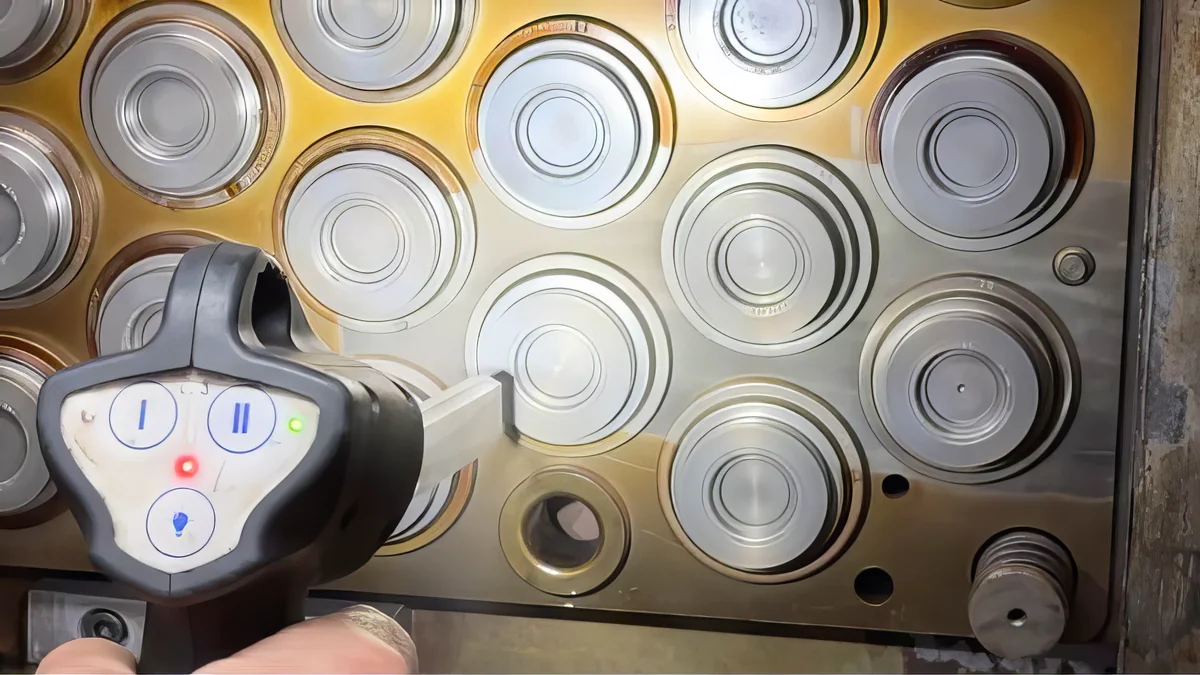
Rubber molds for seals, profiles, tires and industrial rubber parts accumulate release agent residue, vulcanized rubber and off-gas fouling in vents. Traditional cleaning with steel brushes or solvents attacks the mold finish and is labor-intensive.
Cold Jet dry ice blasting offers non-abrasive cleaning without disassembly, suited for automotive rubber production, tire manufacturers and medical rubber molds. This article covers how the technology works for rubber applications.
Why mechanical rubber cleaning falls short
Vulcanized rubber sticks stubbornly to steel. Steel brushes and chemical removal degrade the mold finish across multiple cleaning cycles. For molds with polished interiors or complex geometries (tire tread, profile segments), that becomes a bigger problem over time.
Solvents do work, but require rinsing, drying time and create safety risks for operators. For medical rubber, where contamination is critical, wet methods are also not acceptable.
How Cold Jet works on rubber molds
Cold Jet pellets clean through thermal shock and gas expansion. The rubber residue contracts and releases from the mold surface; sublimation blows residue away. Non-abrasive on the finish, non-conductive for sensors, dry process that goes straight back into production after cleaning.
For tire molds you clean tread segments and sidewall molds without full disassembly. For medical rubber molds, the i³ MicroClean 2 runs with fine pellets and low pressure for delicate finishes.
Concrete benefits for rubber production
- ✓Non-abrasive on polished rubber-mold finishes
- ✓No solvents or rinse steps
- ✓Reaches complex geometries (tire tread, profile segments)
- ✓Cleans off-gas fouling in vents
- ✓Safe for steel, stainless steel and aluminum mold surfaces
- ✓Suited for medical rubber without contamination risk
- ✓Cycle time saving of 50 to 75 percent
- ✓Extends mold service life
Applications on rubber molds
| Mold type | Typical contamination | Recommended machine |
|---|---|---|
| Tire mold (tread segments) | Release agent, vulcanized rubber | PCS Ultra / PLT Ultra |
| Profile mold (seals, gaskets) | Off-gas, rubber residue | PCS Ultra |
| Industrial rubber molds | Stuck-on rubber, additives | PLT Ultra |
| Medical rubber (silicone) | Release agent residue | i³ MicroClean 2 |
| Vulcanization press surfaces | Off-gas fouling | PCS Ultra |
| Rubber dosing channels | Hardened rubber, fouling | PCS Ultra fine pellets |
Recommended Cold Jet machines for rubber mold cleaning
The PCS Ultra covers rubber mold applications from tires to industrial seals. For heavy vulcanization press cleaning we recommend the PLT Ultra. For medical silicone molds and delicate finishes, the i³ MicroClean 2.
Related mold cleaning applications
- ✓In-press cleaning with dry ice blasting
- ✓Screw and barrel cleaning with dry ice blasting
- ✓Blow mold cleaning with dry ice blasting
Want Cold Jet dry ice blasting for your rubber or tire production? Request a no-obligation on-site demo.
Request a demo →Frequently asked questions
Does dry ice blasting attack the rubber mold?
No, Cold Jet is non-abrasive and safe for steel and stainless-steel mold surfaces. Rubber residue and release agent release thermally from the mold; the finish stays intact. Proven safe for both static and flow-through molds.
Does Cold Jet also work on tire molds?
Yes, tire-mold cleaning is a standard application. Tread segments and sidewall molds are cleaned without disassembly. Release agent and rubber residue release; cleaning takes 30 to 60 minutes per mold.
Which Cold Jet machine for rubber-mold cleaning?
The PCS Ultra gives the best flexibility with 28 selectable pellet sizes. For industrial rubber production with heavy fouling, the PLT Ultra. For delicate medical rubber molds, the i³ MicroClean 2.
How much time do I save versus manual scrubbing?
A full rubber mold that takes 2 to 4 hours by hand is typically clean with Cold Jet in 30 to 60 minutes. Cycle time saving of 50 to 75 percent. For producers with high cyclic output, that means substantial extra production.
Is dry ice blasting safe for vulcanization equipment?
Yes, provided the equipment is cooled to working temperature (typically under 80 degrees Celsius). Cold Jet introduces no moisture or chemistry. Vulcanization presses and feed systems can be cleaned safely.