Aero 40FP, Aero 80FP or i³ MicroClean 2: which Cold Jet machine is right for you?

I get the same question on the phone almost every week. Which machine should I buy? Behind it lies the assumption that the heaviest unit cleans best. After 25 years in this trade I know it does not work that way.
In this article I put three machines side by side that we deliver often. For each model you read what it gives you and where it falls short. By the end you know which of the three suits your contamination and your compressed air supply.
Why the heaviest unit is rarely the best choice
Dry ice blasting works with impact energy and with cold. That energy has to match the surface underneath. Too much of it attacks the substrate. Too little leaves the buildup sitting where it is.
Four variables decide the result: working pressure, dosing rate, particle size and available compressed air. Buyers who select on pressure alone usually end up with the wrong unit.
What full pressure blasting means
All three machines are full pressure units running on a single hose. The compressed air accelerates the dry ice inside the nozzle itself. On a system with two hoses that happens further back in the line. You notice the difference in the result straight away.
- ✓Higher impact energy per particle
- ✓A steady jet without pulsing
- ✓Finer control over blast intensity
- ✓Less air and less dry ice once the settings are right
The three models differ in how much energy they deliver. They also differ in particle control and in how much work they take per shift.
Cold Jet Aero 40FP: fine work on a small compressor
The Aero 40FP is the compact full pressure model. It is built for maintenance work where control matters more than speed. We often supply it to companies with a limited compressed air supply.
| Specification | Aero 40FP |
|---|---|
| Dry ice capacity | 18.2 kg (40 lb) |
| Dosing rate | 0 to 2 kg per minute |
| Working pressure | 1.4 to 17.2 bar |
| Air consumption | 1.4 to 4.7 m³ per minute at 5.5 bar |
| Weight | 116.8 kg |
| Drive | 0.25 hp AC motor |
Cold Jet factory specification, as listed on our own machine page.

Where the Aero 40FP earns its keep
- ✓Control cabinets and switch panels
- ✓Cleaning in food and beverage production
- ✓Injection molds and tooling
- ✓Printing presses and graphic machinery
- ✓Preventive maintenance between shifts
The low dosing rate and the controlled pressure prevent etching and deformation. Your operator can work close to a delicate surface. For large areas and thick coatings this model is too light.
Cold Jet Aero 80FP: more throughput, same controls
The Aero 80FP sits on the same platform as the 40FP. The hopper holds twice as much and the dosing rate runs higher. The controls are identical, so your operators have nothing new to learn. The pressure regulator sits on board, with no separate equipment in the hose.
| Specification | Aero 80FP |
|---|---|
| Dry ice capacity | 36.4 kg (80 lb) |
| Dosing rate | 0 to 3.2 kg per minute |
| Working pressure | 1.4 to 20.7 bar |
| Air consumption | 1.4 to 4.7 m³ per minute at 5.5 bar |
| Weight | 176.8 kg |
| Drive | 0.5 hp AC motor |
Cold Jet factory specification, as listed on our own machine page.

Where the Aero 80FP earns its keep
- ✓Plastics and rubber processing
- ✓Production lines in the food industry
- ✓Automotive plants and their suppliers
- ✓Packaging machinery
- ✓General industrial maintenance
This is the model I recommend most often for mixed industrial work. The larger hopper saves refills during a long session. Your crew keeps going without a break.
Cold Jet i³ MicroClean 2: precision work on delicate material
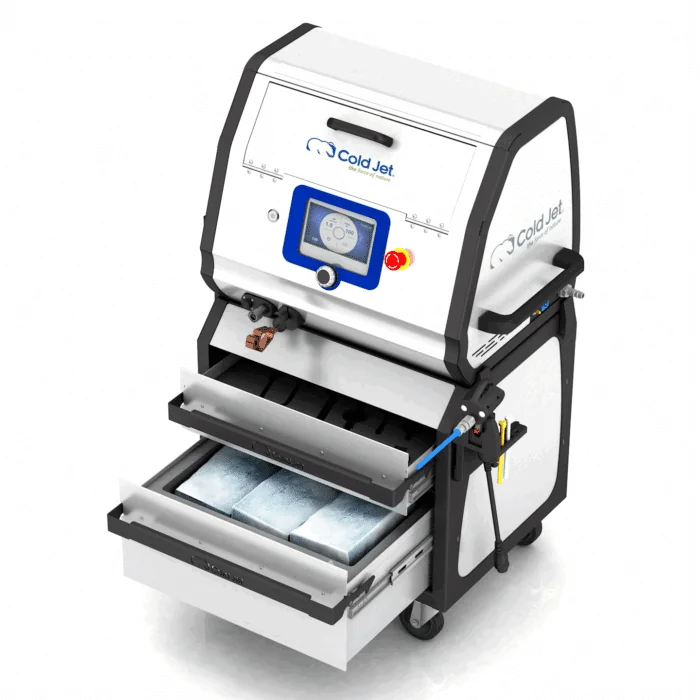
This unit works on a different principle from the Aero series. It runs on dry ice blocks instead of pellets. The machine shaves microparticles off the block while you blast. You clean with many particles that each carry little energy. The second generation adds smarter controls: a 7-inch screen, fixed recipes per application, and a connection that shows you afterwards what actually ran.
| Specification | i³ MicroClean 2 |
|---|---|
| Blasting medium | Dry ice blocks |
| Dosing rate | 0 to 0.7 kg per minute |
| Working pressure | 1.4 to 10 bar |
| Compressed air | 0.3 m³ per minute |
| Dimensions | 79 x 48 x 53 cm |
| Weight | 60 kg |
| Controls | 7-inch display, password-protected programmable recipes, LED for the dry ice level |
| Build | Single hose in 3/8 or 1/2 inch, illuminated applicator, stainless-steel housing on an aluminium frame |
Cold Jet factory specification, as listed on our own machine page.

Where the i³ MicroClean 2 earns its keep
- ✓Circuit boards, switch panels and electronics
- ✓Medical instruments and equipment
- ✓Optical and precision mechanical parts
- ✓Polished molds in chocolate production
- ✓Certified production under ISO or FDA rules
Maximum pressure sits lower than on the Aero 80FP. Even so, this unit often gets delicate material clean faster. More contact points per second do the work, with less force per particle. What the second generation adds is proof: every run is logged, so in an audit you can show when a surface was cleaned and at what setting. It is not the machine for thick coatings, heavy corrosion or large surfaces.
The three models side by side
| Feature | Aero 40FP | Aero 80FP | i³ MicroClean 2 |
|---|---|---|---|
| Dry ice on board | 18.2 kg of pellets | 36.4 kg of pellets | Blocks, LED shows the level |
| Dosing rate | 0 to 2 kg/min | 0 to 3.2 kg/min | 0 to 0.7 kg/min |
| Working pressure | 1.4 to 17.2 bar | 1.4 to 20.7 bar | 1.4 to 10 bar |
| Compressed air | 1.4 to 4.7 m³/min | 1.4 to 4.7 m³/min | 0.3 m³/min |
| Weight | 116.8 kg | 176.8 kg | 60 kg |
| Particles | Solid pellet of 3 mm | Solid pellet of 3 mm | Microparticles off a block |
| Strongest use | Fine maintenance on little air | Mixed industrial work | Delicate work with a record |
How to choose in practice
- ✓Take the Aero 40FP for fine maintenance work and a limited compressed air supply
- ✓Take the Aero 80FP for higher throughput and varied industrial work
- ✓Take the i³ MicroClean 2 when the surface sets the limit
Performance does not depend on pressure alone. Steady dosing, particle size, air efficiency and controls decide the result together. If you are torn between two models, we come by with a demo machine. A test clean on your own contamination tells you more than a spec sheet.
Comparing with other brands as well? Read how the Aero 40FP and the i³ MicroClean 2 measure up against their ICS counterparts.
Want to know what the right machine actually returns? Our ROI calculator runs your cleaning frequency, hourly rate and downtime cost over five years.
Calculate your payback →Would you rather talk through your own contamination first? Ask us for machine advice →
For the broader picture, see our buyer’s guide for production sites. Every model is listed on the Cold Jet overview page.
Frequently asked questions
What is the difference between the Aero 40FP and the Aero 80FP?
The 80FP has a hopper twice the size and a higher dosing rate. Maximum working pressure is 20.7 bar, against 17.2 bar on the 40FP. Both machines use the same controls and the same radial dosing system. On long sessions the 80FP mainly saves you refill time.
Why does the i³ MicroClean 2 run at a lower pressure?
This unit is built around fine particles rather than maximum force. The machine shaves microparticles off a dry ice block. More particles reach the surface, each with less energy per impact. On delicate material that gives a better result than high pressure.
How much compressed air do I need for an Aero machine?
Count on 1.4 to 4.7 m³ per minute at a line pressure of 5.5 bar. Your compressor has to deliver that continuously, not just at peak. With a smaller supply you will fall short of the rated dosing rate. We measure this up front together with your technical department.
Can I use the same dry ice in all three machines?
No. The two Aero machines run on 3 mm pellets. The i³ MicroClean 2 works from dry ice blocks and shaves them into fine particles itself. We supply both types on call.
Can I try a machine first?
Yes, we run a test clean on your own contamination. You see the result on your own material straight away. After that we advise which model fits your frequency and your compressed air supply. That trial is our normal first step.