


Dry ice blasting in the automotive industry: weld cells, paint booths and injection molds
In automotive production, machines run continuously and downtime is expensive. Weld spatter builds up on welding robots and disrupts the precision of weld joints. E-coat and paint accumulate in spray booths and cause rejected parts. Injection molds for bumpers, dashboards and interior parts become contaminated and lower first-pass yield. Each of those contamination types has a direct impact on production, and the right cleaning method keeps it under control.
This article describes how ColdBlast deploys dry ice blasting for the three largest cleaning applications in automotive. You will learn which approach works per application, how much downtime you can recover, and which machines ColdBlast recommends. At the end you can calculate your scenario in our ROI calculator.
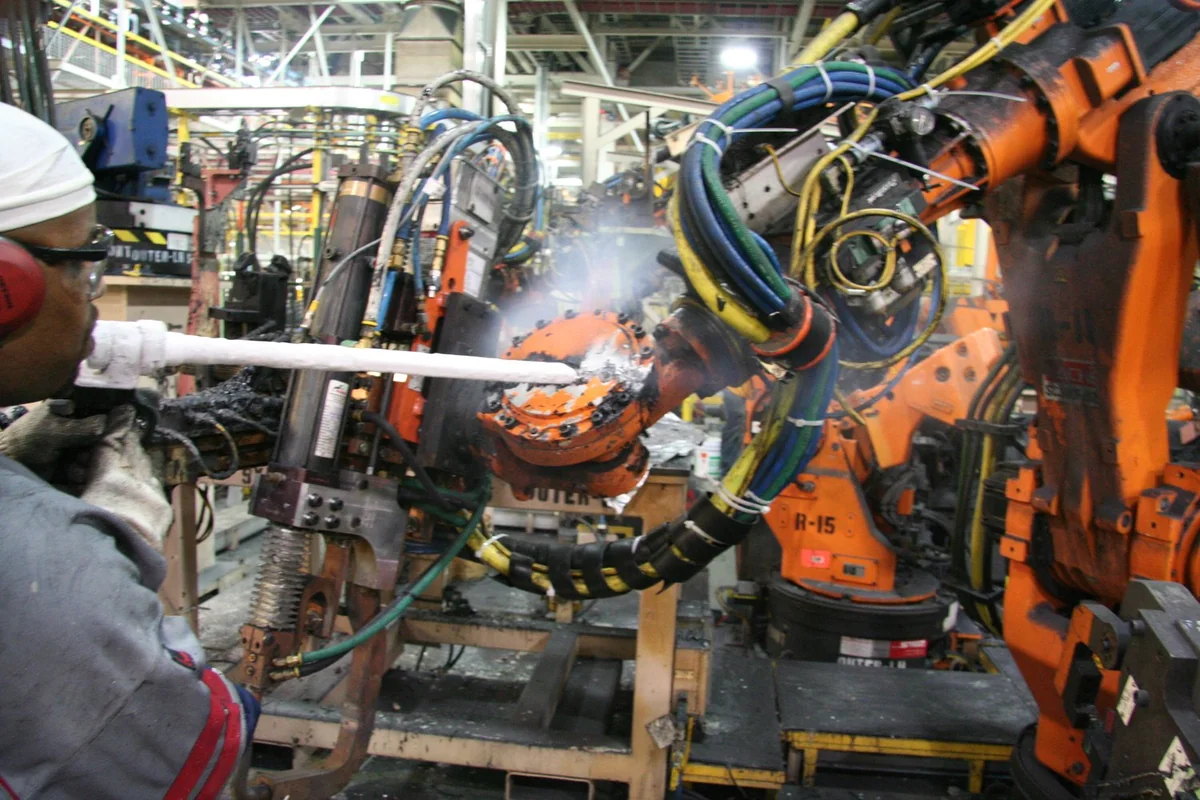
Application 1: welding robots and weld cells
Weld spatter and slag are the most frequent contamination in automotive weld cells. With every weld, hot metal particles spray onto the robot arm, the weld fixture and surrounding structures. Those particles harden and form a layer that limits the robot’s freedom of movement, disrupts sensors and affects weld quality when they enter the weld zone.
Weld cells are traditionally cleaned by hand with grinding stones, chisels and anti-spatter sprays. This takes six to eight hours per robot on average and damages surfaces because abrasive tools act on coated robot arms. ColdBlast cleans a welding robot with a Cold Jet Aero 40FP or Aero 80FP in thirty to ninety minutes, non-abrasive and without touching the robot coating surface.
An example from Tier 1 automotive practice: one manufacturer reduced cleaning time per welding robot from 7.2 to 0.5 hours after switching to dry ice blasting. On a weld cell with ten robots, that means seventy fewer downtime hours per maintenance stop.
Application 2: spray booths and e-coat installations
In the paint and coating line, e-coat, primer and topcoat residue build up on booth walls, floors, transport bars and rotation fixtures. With wet cleaning using high pressure or solvents the booth infrastructure gets wet, and drying and resetting the ventilation extend downtime. Any residue left behind causes coating defects in the next spray run.
Dry ice blasting removes paint and coating deposit without water, without solvents and without the booth going offline for drying time. ColdBlast recommends an Aero 80FP or PLT Ultra for booth walls with thick coating layers and an i³ MicroClean 2 or PCS Ultra for delicate fixture components and sensors in the booth. Using both machines in one maintenance stop cuts total booth cleaning downtime by forty to sixty percent compared with wet methods.
Application 3: injection molds for automotive parts
Bumpers, dashboards, door panels and interior parts are injection molded in high volumes. The molds for these parts often process glass-fibre reinforced plastics, flame retardants and colour pigments that cause aggressive plate-out. Automotive injection molds therefore usually need cleaning more often than standard engineering plastic molds.
ColdBlast recommends a Cold Jet PCS Ultra with variable pellet size for automotive injection molds. Particle Control technology scales pellet size per cavity and contamination type, so one machine handles both delicate surfaces and harder plate-out. Read the full mold schedule in our article on preventive mold maintenance.
Comparison per automotive application
| Application | Traditional cleaning time | Dry ice cleaning time | Recommended machine |
|---|---|---|---|
| Welding robot, spatter and slag | 6-8 hours per robot | 0.5-1.5 hours per robot | Aero 40FP or Aero 80FP |
| Spray booth walls and fixtures | 4-8 hours; plus drying time | 2-4 hours; no drying time | PLT Ultra + i³ MicroClean 2 |
| Automotive injection mold | 2-6 hours out-of-press | 0.5-1.5 hours in-press | PCS Ultra variable pellet |
| Transport bars and hangers in the paint line | 1-3 hours; chemical or abrasive | 0.5-1 hour; non-abrasive | Aero 40FP |
Calculate your automotive saving
How many production hours do you gain in your automotive production line with dry ice blasting? Our ROI calculator runs your cleaning frequency, downtime costs and machine configuration through a 5-year comparison.
Calculate my saving →Prefer to walk through your production line with a ColdBlast specialist? Request a demo clean on site. Request demo →
Frequently asked questions
Does dry ice blasting damage the paint or coating on welding robots?
Not with the correct settings. For welding robots, ColdBlast uses medium-coarse pellets that remove weld spatter and slag without touching the robot coating. The technology is non-abrasive; pellets sublimate on contact without abrasive action on the surface. ColdBlast always verifies settings on a test surface before starting the cleaning session.
Can the weld cell stay active during cleaning?
Dry ice blasting is non-conductive, but in weld cells with active welding equipment ColdBlast recommends putting the cell into maintenance mode and locking out the welding equipment per your LOTO procedure. Cleaning time per robot does not increase; safety preparation typically takes five to ten minutes.
How frequently should weld cells be cleaned?
ColdBlast advises based on welding intensity and process type. For MIG/MAG welding with high spatter production a cleaning interval of four to eight weeks per robot is appropriate. With anti-spatter spray programmes that can extend to twelve weeks. ColdBlast establishes a cleaning frequency after a short intake about your welding process.
Can dry ice blasting be automated in weld cells?
Yes. Cold Jet offers integrated dry ice blasting systems that can be linked to the weld cell’s PLC. ColdBlast advises on integration options; automated cleaning is interesting for high-volume weld cells where cleaning time is incorporated directly into the cycle time.
Does dry ice blasting work on all paint types in spray booths?
Dry ice blasting is effective on e-coat, primer, solvent-borne and waterborne paint. For UV-cured coatings and powder coat the adhesion is sometimes too strong for dry ice blasting alone; in those cases ColdBlast combines it with mechanical preparation. We assess this per booth type during the demo clean.
How does dry ice blasting compare with anti-spatter spray for welding robots?
Anti-spatter spray forms a temporary protective layer but does not address existing buildup. Dry ice blasting removes the existing slag and spatter layer completely. The combination works best: dry ice blasting at the maintenance stop to remove existing deposit, supplemented with anti-spatter spray after cleaning as a preventive measure between sessions.
Which Cold Jet machine has ColdBlast deployed most in automotive environments?
For welding robots and weld cells the Cold Jet Aero 40FP is the machine ColdBlast uses most: robust, high-output and suited for the intensive environment of a weld cell. For spray booth fixtures and delicate sensors the i³ MicroClean 2 is the complement. See the full range in our machine selection guide.
