


Which Cold Jet machine fits your production? A buyer’s guide for production sites
Production companies evaluating dry ice blasting quickly run into a choice problem. The Cold Jet portfolio counts eight serious models, from compact entry units to heavy-duty machines with Particle Control System. Which one fits your contamination, production frequency and operator level? The wrong choice means either overinvestment or a machine that cannot handle your peak demand.
This article describes the selection framework ColdBlast applies with production companies. You will learn which four criteria are decisive, get the full portfolio in a table, and see per production type which machine usually wins. At the end you can calculate your scenario in our ROI calculator or request personal advice.
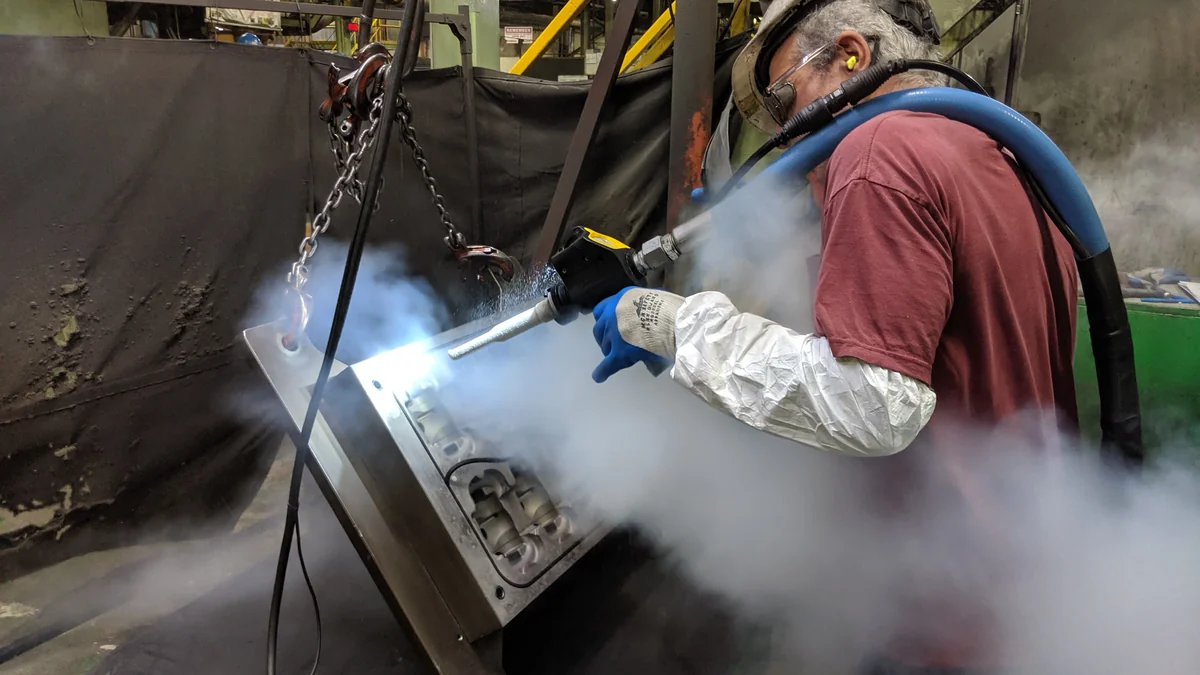
Why machine choice is more than power
Many buyers reduce machine choice to one variable; “how many kilograms of dry ice per hour can the blasting power handle”. That is an incomplete question. An overspecified machine causes operator fatigue, cold shock on delicate molds, and unnecessary compressed air costs. An underspecified machine becomes a bottleneck at peak cleaning.
ColdBlast approaches machine choice from four questions. Which contamination must go. How often. On what type of surface. By whom. Only when those four answers are fixed does it make sense to look at specific models.
The four main selection criteria
| Criterion | What it determines |
|---|---|
| Contamination type | Soft buildup requires fine pellets and low pressure; hard buildup requires coarse pellets and higher pressure. Particle Control System scales both within one machine. |
| Cleaning frequency | Daily to weekly use calls for an industrial Aero or PCS Ultra; sporadic use can do with an i3 MicroClean. |
| Surface and finish | Polished finish on molds only tolerates fine pellets at low pressure; metal housings and cooling fins tolerate coarser pellets. |
| Operator profile | Lighter units like i3 MicroClean 2 are designed for varying operators; heavy-duty Aero 80FP or PLT Ultra requires fixed operator training. |
The Cold Jet portfolio at a glance
The table below shows the complete Cold Jet portfolio ColdBlast supplies in the Netherlands, with indicative positioning per machine.
| Model | Type | Strengths | Typical application |
|---|---|---|---|
| i³ MicroClean | Entry, compact | Lightweight, low threshold, easy to operate | Delicate cleaning, electronics, small molds |
| i³ MicroClean 2 | Entry+, successor | Improved dosing, longer service life, faster switching | Delicate production, small-scale food industry |
| IceRocket | Entry pellet | Pellet format, low price, simple operation | General cleaning, restoration, automotive |
| Aero 40FP | Mid-range industrial | Robust frame, powerful output, good pressure-handling balance | Injection molders, automotive welding cells, tool building |
| Aero 80FP | Heavy-duty industrial | High volume, premium performance, weekly cycles | Production sites with heavy contamination and frequent cleaning |
| PCS Ultra | Particle Control premium | 28 pellet sizes within one machine, variable pressure | Injection molders with varied mold types |
| PLT Ultra | Heavy-duty premium | High pressure up to 20 bar, aggressive cleaning | Industrial with hard buildup, fire residue, concrete |
| IceTech Elite 20 | Entry heavy-duty | Simple operation, robust, low threshold | General industrial cleaning, entry-level organisations |
| SDI Select 60 | Specialty | For specialist applications | Niche applications, on request |
Selection matrix per production type
| Production type | Recommended entry | Recommended heavy-duty |
|---|---|---|
| Bakery and patisserie | i³ MicroClean 2 | Aero 40FP |
| Meat and fish processing | IceRocket | Aero 80FP |
| Dairy and chocolate | i³ MicroClean 2 | Aero 40FP |
| Packaging industry | IceRocket | PLT Ultra |
| Standard injection molding | PCS Ultra | PLT Ultra |
| Micro / medical injection molding | PCS Ultra with finest setting | PCS Ultra |
| Automotive welding cells | Aero 40FP | Aero 80FP |
| Fire remediation and restoration | IceRocket | PLT Ultra |
| Switchgear and electronics | i³ MicroClean 2 | i³ MicroClean 2 |
When entry, when heavy-duty
The choice between entry and heavy-duty depends almost exclusively on your cleaning frequency and the severity of your contamination. ColdBlast applies a simple rule of thumb; at more than 100 cleaning hours per year or hard carbonised buildup, a heavy-duty machine wins on TCO. At sporadic cleaning or delicate surfaces, an entry unit is sufficient.
A common mistake is overinvestment from caution. Production companies often pick a heavier model than necessary, resulting in higher depreciation and operator fatigue. ColdBlast advises a trial cleaning before the final configuration is locked in.
Calculate your machine scenario
Which Cold Jet machine delivers the fastest payback period on your production? Our ROI calculator runs your cleaning frequency, operator rate and downtime cost through a 5-year comparison, for both entry and heavy-duty configurations.
Calculate my choice →Prefer to walk through your production situation with a ColdBlast specialist? Request personal machine advice; we match your contamination and frequency to the right configuration. Request machine advice → For the complete portfolio with specs and lightbox see our Cold Jet machines overview page.
Frequently asked questions
What is the difference between i³ MicroClean and PCS Ultra?
The i³ MicroClean is a compact entry model for delicate cleaning with fixed pellet size. The PCS Ultra is a premium heavy-duty machine with Particle Control System that switches 28 pellet sizes within one unit. For injection molders with varied mold types the PCS Ultra is the right choice; for consistently delicate work the MicroClean suffices.
Can an entry model be upgraded to heavy-duty?
No, that is not a gradual upgrade. You can keep your entry machine as a second unit for delicate tasks and deploy a heavy-duty machine in parallel for heavy cycles. ColdBlast recommends this dual-machine setup more often than expected; it extends the service life of both units.
How much compressed air do I need for an Aero 80FP?
The Aero 80FP operates optimally at 7 to 10 bar compressed air with sufficient flow. In most production environments the existing compressor suffices. ColdBlast verifies this during the advice phase; in case of doubt an on-site measurement follows.
Which machine fits varying operators?
For varying operators the i³ MicroClean 2 is most suitable; operation is intuitive and the unit is lighter than industrial models. For heavy-duty machines like Aero 80FP or PLT Ultra, ColdBlast advises fixed operator training and certification.
Which Cold Jet machine works in ATEX environments?
For ATEX zones Cold Jet offers specific explosion-proof configurations on request. ColdBlast configures these machines based on your ATEX zoning documentation. Standard machines are not ATEX-certified.
Can I try a Cold Jet machine before purchase?
Yes. ColdBlast visits your site for a trial cleaning on your own contamination. You see directly which machine and pellet configuration gives the best result. Only then does the purchase or lease decision follow.
Is a second-hand Cold Jet machine a good start?
For production companies that want to validate dry ice blasting first or want to phase their budget, a second-hand demo unit is a reasonable route. ColdBlast offers second-hand machines with dealer warranty and original parts. See the pre-owned Cold Jet machines at ColdBlast.